
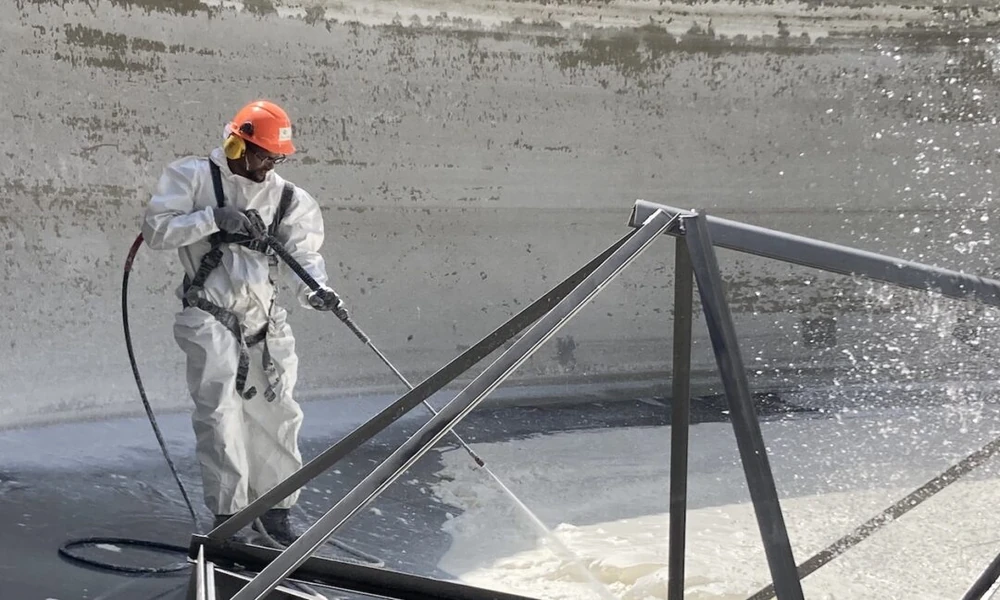
The first time a plant manager watches a blocked line get cleared at 20,000 PSI, the reaction is almost always the same: why did we ever pay people to scrape this by hand? That moment of clarity is the whole argument for water over chemicals, and it holds up long after the novelty wears off.
Water is cheap, it doesn’t leave a residue you have to neutralize, and it doesn’t change the chemistry of whatever you’re cleaning. A crew that knows what it’s doing can strip decades of baked-on carbon out of a vessel in an afternoon and walk away without a single drum of hazardous solvent. That last part matters more every year, because disposal costs keep climbing and regulators keep tightening the rules on what you can send to a landfill.
The catch is that pressure is only half the story. A rental unit and a guy in a rain suit is not a cleaning program, and the difference between a good job and a damaged vessel often comes down to whether the operator understood the substrate before the first trigger pull. Reputable hydroblasting services in Dallas treat that judgment call as the core of the job rather than an afterthought, because getting it wrong is expensive in both directions.
What hydroblasting actually removes
Think of it as a spectrum of filth. At the soft end you’ve got grease, food residue, and wet sludge. Toward the middle sits scale, rust bloom, and polymer buildup. At the hard end you find ceramic-lined reactor deposits, hardened epoxy, and heat exchanger fouling that would laugh at a pressure washer.
Water handles all three, but the nozzle, the flow rate, and the working pressure change dramatically as you move along that spectrum. A food plant cleaning a mixing tank might run a few thousand PSI with a rotating head. A refinery pulling coke out of a drum is working in a
completely different universe of force.
What stays constant is the mechanism. Kinetic energy does the cutting, and water carries the debris away as it goes. No grit, no media to recover, no abrasive dust cloud hanging over your crew. That’s why facility teams in dusty processing environments tend to prefer it, even when a chemical method would technically work.
Solvents, sandblasting, or water
Every cleaning method is a trade. Here’s how the three most common options at industrial sites actually compare.
| Method | Best fit | Main drawback |
|---|---|---|
| High pressure water | Tanks, vessels, lines, heat exchangers | Needs trained operators and water containment |
| Chemical solvents | Delicate surfaces and light organic films | Disposal cost, worker exposure, residue |
| Abrasive blasting | Surface prep where a profile is required | Dust, media recovery, potential surface loss |
If I’m cleaning a 40 foot storage tank with a decade of settled product in the bottom, I’m picking water and I’m not agonizing over it. If I need a specific anchor profile on steel before coating, I want an abrasive. The mistake is treating any one of these as a universal answer, and you’ll see that mistake in maintenance logs all the time.
Handling and disposal of the waste stream that comes out the other end is where the cost difference really shows up. The Environmental Protection Agency sets the framework for how industrial waste is managed, and the more hazardous your cleaning chemicals are, the more of that framework you have to navigate. Water sidesteps a lot of it.
How to tell a real crew from a rental truck
This is where a lot of plants get burned. Anyone can lease a high pressure pump. Not everyone can run it without gouging a vessel wall or cutting through a heat exchanger tube.
Ask these questions before you sign anything:
- Who calculates the pressure and flow for my specific deposit and substrate?
- What containment and wastewater recovery do you bring, and where does the water go?
- Can you work in a confined space, and does your team hold the rescue certifications that entry requires?
- Do you document the pressures used, or do I just get an invoice?
- What happens if the vessel surface gets damaged?
A crew that hesitates on the first question is a crew that’s guessing. The one that pulls out a job plan with numbers on it has done this before, and those numbers are the difference between cleaning a tank and replacing one.
Confined space work deserves its own scrutiny. The Occupational Safety and Health Administration treats permit-required confined spaces as one of the more hazardous categories of industrial work, and a hydroblasting job inside a tank is exactly that scenario. A contractor who shrugs at the topic is telling you something.
A short field checklist
Before the truck backs in, walk through this with your own maintenance lead, not just the contractor.
- Confirm the deposit type. Is it organic, mineral, or a mix? This drives the pressure range.
- Identify the substrate thickness and any linings, coatings, or delicate internals.
- Map the water. Where does it enter, where does it exit, and who owns the runoff?
- Check isolation. Lockout and tagout on every feed line, or the job stops.
- Agree on the acceptance test. Visual inspection, a wipe sample, or a documented pass, but something specific.
Skipping step four is how people get hurt, and it’s the step most likely to get waved off when a schedule is tight. Don’t wave it off.
Fire protection systems are a related headache that catches plants off guard, since residue in a tank or line can affect equipment that’s tied into suppression. The National Fire Protection Association publishes the standards that govern those systems, which is worth a look if your cleaning scope touches anything connected to them.
What it costs you to get this wrong
A damaged vessel wall is a shutdown. A failed confined space entry is worse than that. And a poorly contained washdown that sends contaminated water into the wrong drain can turn a routine maintenance item into a regulatory event.
The flip side is genuinely attractive. Clean equipment runs cooler, holds pressure better, and lasts longer. Heat exchangers that were fouled start transferring heat the way they were designed to. Pumps stop cavitating. You get your capacity back without buying anything new.
That’s the real pitch for water based cleaning. Not that it’s cheap, though it usually is once you count disposal. It’s that it restores the equipment you already own to something close to its original performance, and it does it without introducing a new chemical problem for you to manage.
So here’s the question worth putting to your maintenance team this quarter: when was the last time anyone actually measured the fouling in your worst-performing vessel? Not eyeballed it. Measured it. If nobody can answer, you’ve probably already found your next project, and the cleaning method is a much easier decision than you think.