
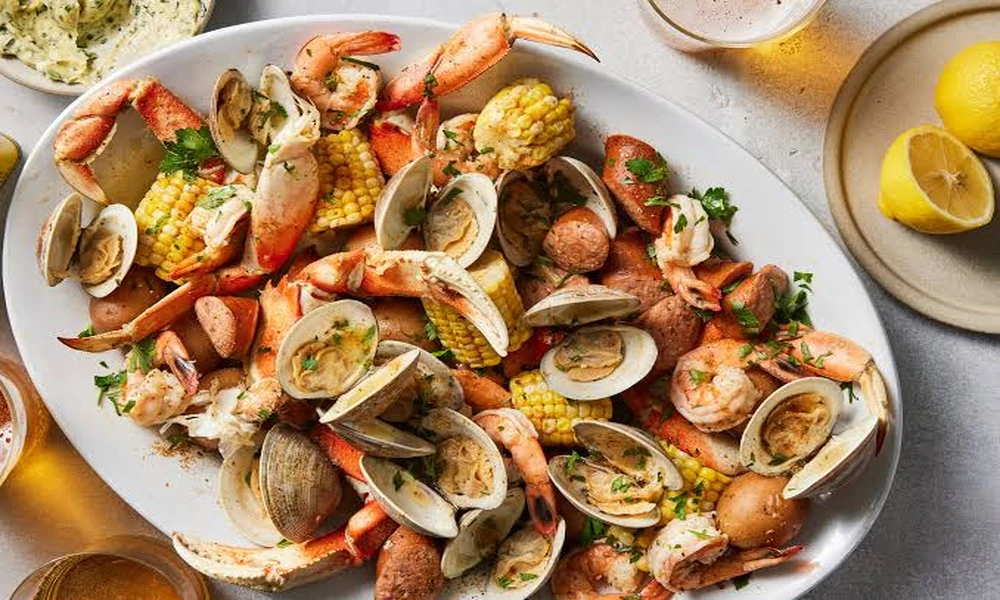
Eight people, one paper-covered table, zero forks, and a bag of crab legs slathered in garlic butter. Someone’s elbow is in someone else’s sauce. Everybody’s laughing. That specific chaos is exactly why the seafood boil keeps spreading from city to city, coast to coast.
This isn’t just a food trend. It’s a format that solves a genuine problem with modern group dining: the awkward, overly formal, dead-quiet dinner where half the table stares at their phones between courses. The seafood boil demands full participation. You can’t scroll while your hands are covered in Old Bay seasoning. That’s the point.
America’s Appetite for Shellfish Has Never Been Stronger
The hunger driving this dining format is real and measurable. In 2023, per capita consumption of seafood in the United States was 19.1 pounds , according to the annual NOAA Fisheries of the United States report. That’s not a blip. It’s the result of decades of steady demand growth.
In fact, over the last three decades, demand for farm-raised and wild-caught seafood has expanded as consumers’ tastes for finfish and shellfish have grown, with per capita seafood consumption climbing 30 percent in that period , according to the USDA Economic Research Service. Shellfish, in particular, sits at the center of that growth. It’s celebratory by nature, and the boil format turns it into an event rather than just a meal.
Restaurant operators noticed. Seafood boil concepts, which had long existed as regional traditions in Louisiana and along the Gulf Coast, started migrating north and west. Then Asian immigrants who grew up eating shellfish in Vietnam, Thailand, and Southeast Asia began adding their own flavor profiles, and something genuinely new emerged.
Where Cajun Heat Meets Asian Spice
The fusion happened organically, not in a test kitchen. It’s easy enough to draw parallels between Southeast Asian and Cajun cuisines, with a common emphasis on vibrant flavors, relying heavily on chile peppers and pungent herbs, and shellfish sharing the spotlight in both culinary traditions. Once immigrant cooks who already knew how to work with lemongrass, ginger, and fermented shrimp paste got their hands on a Louisiana boil pot, the results were something American diners had never seen before.
The flavor profile that came out of that collision, spicy, aromatic, savory, with layers of heat that build rather than just burn, is genuinely difficult to replicate at home. That’s a meaningful advantage for any restaurant format. You can’t order this experience through a delivery app and have it arrive as good as it is at the table. The steam, the sauce temperature, the communal mess, all of that disappears in transit.
That’s why the Asian Cajun seafood restaurant model has proven so durable. The food and the format are inseparable. You come for the crab, you stay for the experience, and you come back because you can’t recreate it.
The Three Locks: What Makes a Boil Work as a Group Experience
Not every restaurant concept scales naturally to big tables. Sushi can feel precious and slow at a group of ten. Pizza is fine but it’s nobody’s special occasion. The seafood boil, though, thrives at scale. Here’s a framework for understanding why, one I’ll call the Three Locks:
- Flavor Lock. The sauce is the same for everyone at the table, poured over shared ingredients from one bag. There’s no “my dish vs. your dish” hierarchy. You’re all eating the same thing, with heat levels the only real individual choice.
- Format Lock. No plates, no silverware, no formal service rhythm. The absence of those conventions removes the social pressure that makes white-tablecloth dinners exhausting for large groups. Everybody’s hands are in the same situation.
- Memory Lock. You walked out smelling like garlic butter. You signed the wall. There was sauce on someone’s shirt. Those moments generate the stories that bring groups back six months later because somebody inevitably says, “Remember that crab place?”
This is a framework no algorithm derives from a keyword. It comes from watching what actually happens at those tables and working backward to the mechanics.
The Dining-Out Rebound Is Sending Groups Back to Restaurants
The timing of the seafood boil’s national expansion has been fortunate. In a 2024 national survey by US Foods, 55% of consumers said they prefer dining out at restaurants rather than ordering takeout or delivery, a sharp increase from the 43% who favored dining out in 2023 , according to Auguste Escoffier School of Culinary Arts. That recovery from pandemic-era takeout habits has been fastest among younger diners who view the restaurant itself as the destination, not just the food.
Millennials and Generation Z are more likely to view eating out as a shared event and eager to dine in large groups, whether meeting new people or out with old friends, seeing it as a celebration to share. A seafood boil delivers exactly that. It’s not a dinner where you happen to sit next to people. It’s an activity that happens to involve dinner.
That shift toward experiential eating is why cities that never had a boil culture, Phoenix, Las Vegas, Atlanta, Seattle, are now home to packed seafood boil restaurants on Friday nights. The format traveled because it solved a need that transcends regional tradition.
What to Expect Your First Time
If you’ve never been, the setup is disorienting in the best way. You choose your shellfish, your seasoning blend, and your heat level. The food arrives in a plastic bag, inside a metal bowl or dumped directly onto the paper-covered table. There are no plates. There is a bib, which you will definitely need.
A few things worth knowing before you go:
- Order more than you think. Shellfish loses volume when you crack it open.
- The corn and potatoes in the bag absorb more seasoning than the crab. They’re not an afterthought.
- Bring people who don’t mind getting messy. This is the wrong venue for a first date with someone you’re trying to impress.
- Ask your server what heat level locals actually order. “Medium” at a serious boil spot is often hotter than “extra hot” somewhere else.
The whole thing moves fast. You’re done in 90 minutes and you feel like you’ve been at a party, not a dinner.
Why This Format Keeps Growing
The seafood boil’s staying power comes down to something simple: it’s one of the last restaurant formats that genuinely cannot be replaced by delivery or a meal kit. The experience is the product. You can mail someone crab legs and a spice blend. You cannot mail the noise, the steam, the shared table covered in paper, the mandatory conversation that happens when everyone’s hands are full.
That irreplaceability is rare in the current restaurant landscape, where almost every other format has been successfully packaged for off-premises consumption. The boil restaurant holds the experience hostage in the best possible way. You have to show up to get it.
So the next time your group is stuck in the circular debate about where to eat, stop overthinking it. Pick a boil spot. Nobody ever leaves a seafood boil saying they wish they’d ordered a salad instead.